Key takeaways
- Send the first welcome email immediately; delays waste the moment of highest interest.
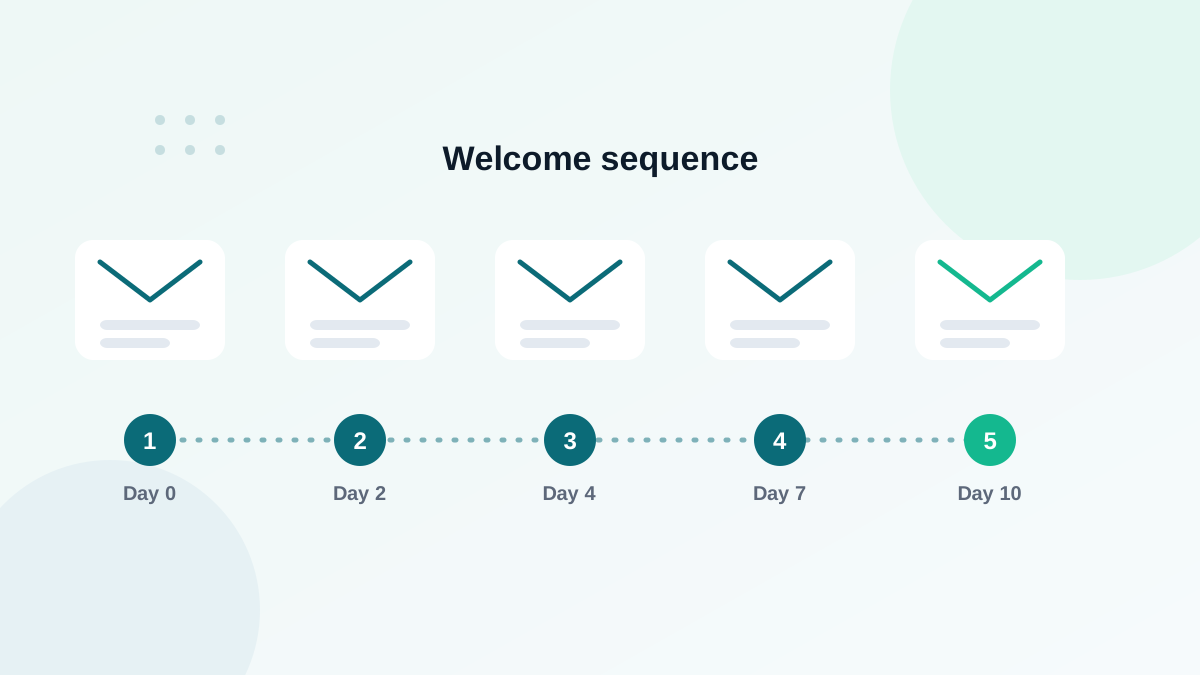
- Five emails over about two weeks is a strong default: deliver, introduce, educate, prove, offer.
- Each email should have one goal and one main call to action.
- Ask subscribers to reply: replies are a powerful positive signal for inbox placement.
- Review results after 30 days and improve the weakest email first.
In this guide
- What a welcome email sequence is
- Why welcome emails matter so much
- The 5-email welcome sequence I recommend
- Email 1: Deliver the promise (send immediately)
- Email 2: Introduce yourself and start a conversation
- Email 3: Give your best advice
- Email 4: Show proof
- Email 5: Make a clear offer
- Timing and setup best practices
- Welcome sequence variations by business type
- How to measure and improve your sequence
- Welcome sequence checklist
- Frequently asked questions
What a welcome email sequence is
A welcome email sequence (also called a welcome series or onboarding sequence) is a set of automated emails sent to every new subscriber, in a fixed order, over the days that follow their signup. Instead of dropping new people straight into your regular newsletter, you introduce yourself, deliver value and guide them towards a first action.
It is one of the most profitable automations you can build, for a simple reason: a new subscriber is at the peak of their interest. They just gave you their email address because they wanted something. The days that follow are your best chance to show that you deserve their attention.
Why welcome emails matter so much
- Highest engagement you will ever get. Welcome emails are consistently among the most opened and clicked emails in any program.
- They set expectations. Subscribers learn what you send, how often, and why it is worth opening. Clear expectations mean fewer unsubscribes and fewer spam complaints later.
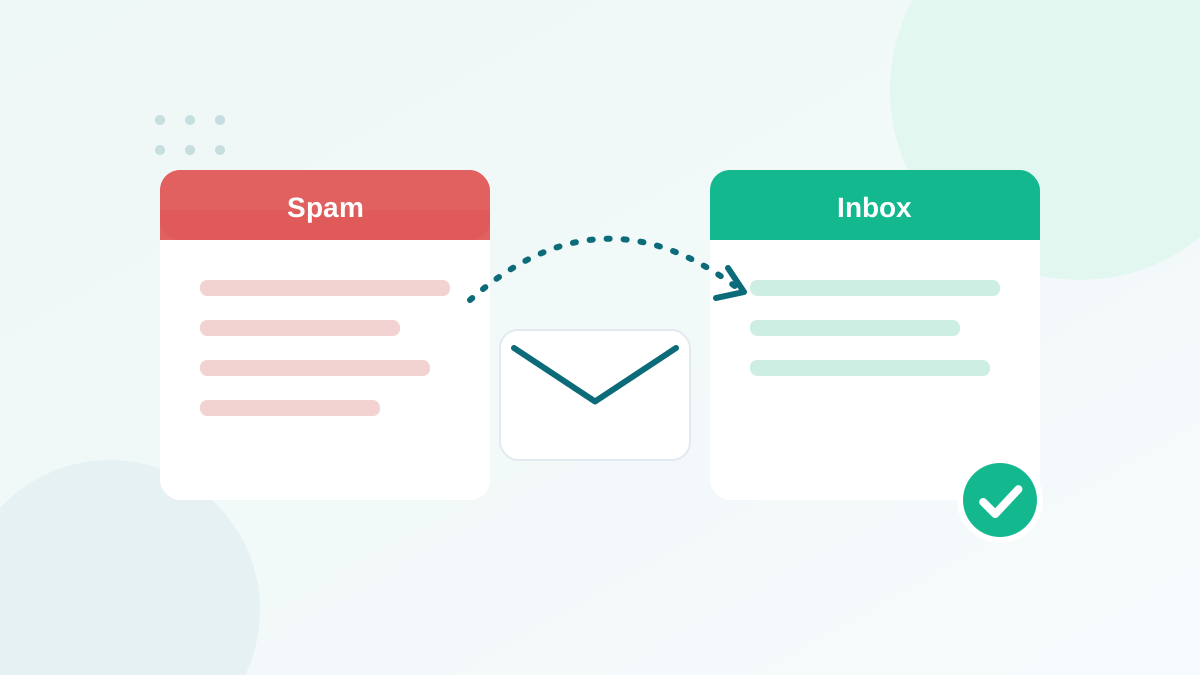
- They train the inbox. When new subscribers open, click and reply, mailbox providers learn that your emails are wanted. This positive engagement helps your future campaigns reach the inbox.
- They work automatically. You write them once and they work for every subscriber, every day.
- They catch bad addresses early. If a welcome email bounces, you know immediately that the address was invalid and can remove it before it hurts your reputation.
The 5-email welcome sequence I recommend
There is no universal perfect sequence, but this structure works for most newsletters, service businesses and online shops. Each email has one job.
| When | Goal | Main call to action | |
|---|---|---|---|
| 1. Deliver | Immediately | Deliver what you promised and confirm they are in the right place | Download / access the resource |
| 2. Introduce | Day 1 or 2 | Tell your story and why you are worth following | Reply with their biggest challenge |
| 3. Educate | Day 3 or 4 | Give your best piece of advice | Read your most useful guide |
| 4. Prove | Day 6 or 7 | Show results, examples or testimonials | See a case study or product |
| 5. Offer | Day 9 to 12 | Make a clear, relevant offer | Buy, book or start a trial |
Adjust the delays to your audience. A store with impulse purchases can be faster; a high-value B2B service can space things out more.
Email 1: Deliver the promise (send immediately)
This is the email people are waiting for. Send it within seconds of signup. If you promised a checklist, the checklist must be in this email, above everything else.
Subject line ideas: "Here is your checklist", "Welcome! Your template is inside", "You're in. Start here."
Hi {first name},

Thanks for joining! As promised, here is your
[resource name]: [link/button]

Quick tip: start with section 2. It takes 10 minutes
and gives the fastest result.

Over the next few days I'll send you a few short emails
with the most useful things I've learned about [topic].
After that, you'll get my newsletter every [day/frequency].

Talk soon,
[Your name]Ask people to add your address to their contacts or move your email to their main inbox. It is a small step that improves future placement, especially with Gmail tabs.
Email 2: Introduce yourself and start a conversation
Now that the promise is delivered, explain who you are, in a way that is about the reader. Why did you start? What problem do you help people solve? Then ask a simple question and invite a reply.
Replies are gold. They tell you what your audience needs, and they send a strong signal to mailbox providers that real people want your messages.
Subject line ideas: "Why I started [brand]", "Quick question for you", "Can I ask you something?"
Hi {first name},

I'm [name]. For the past [X] years I've been helping
[audience] with [problem].

I started [brand] because [short, honest reason].

I'd love to know: what's your biggest challenge with
[topic] right now? Just hit reply. I read every answer.

[Your name]
Email 3: Give your best advice
Share the single most useful thing you know about your topic. Not a teaser: real value. This email is where subscribers decide that your emails are worth opening.
Link to your best piece of content. For an email marketing audience, for example, that could be a guide on why emails go to spam and how to fix it.
Subject line ideas: "The mistake I see most often", "Do this one thing first", "The 10-minute fix for [problem]".
Email 4: Show proof
Before making an offer, show that what you recommend works. Use a real example, a before-and-after, a customer story, or a short testimonial. Keep it specific and honest. One concrete example beats ten vague claims.
Subject line ideas: "How [customer] solved [problem]", "What happened when we tried this", "Real results from [audience]".
Email 5: Make a clear offer
By now, your subscriber has received value three times. It is the right moment to present a relevant offer: your product, your service, a consultation, or a trial. Explain who it is for, what it does, and what happens next. Add a reason to act now if you have a genuine one, such as a welcome discount with a real end date.
Subject line ideas: "Ready for the next step?", "A welcome gift for you (ends Friday)", "Here's how I can help".
After email five, the subscriber joins your regular newsletter. Mention it in the last email so the change does not come as a surprise.
Timing and setup best practices
- Trigger: start the sequence when a contact is added to your list, after confirmation if you use double opt-in.
- Avoid overlap: exclude subscribers in the sequence from regular campaigns, or at least avoid two emails on the same day.
- Exit conditions: if someone buys during the sequence, move them out of the sales emails and into a customer onboarding flow.
- Personalization: use the first name if you collect it, but never depend on it. Set a fallback such as "there".
- Mobile first: most welcome emails are read on phones. Short paragraphs, large buttons, one column.
- Authentication: make sure your sending domain is authenticated before you launch. Here is my SPF, DKIM and DMARC setup guide.
Welcome sequence variations by business type
Online shop
Email 1 delivers the welcome discount, email 2 presents best sellers, email 3 explains what makes your products different, email 4 shares customer reviews, email 5 reminds them the discount is about to expire.
Service business or consultant
Email 1 delivers the resource, email 2 tells your story, email 3 teaches a method, email 4 shows a client result, email 5 invites them to book a call.
Blog or newsletter
Email 1 confirms the subscription and shares your top three articles, email 2 asks what they want to learn, email 3 delivers a deep tip, email 4 explains how to get the most out of your newsletter, email 5 presents your paid product or sponsor if you have one.
How to measure and improve your sequence
Let the sequence run for about 30 days, then review each email individually:
| Signal | What it means | What to do |
|---|---|---|
| Low clicks on email 1 | The resource is hard to find | Put the button at the top, make it bigger |
| Unsubscribes spike on one email | That email misses expectations | Rewrite it or move it later |
| Few replies to email 2 | The question is too vague | Ask something specific and easy to answer |
| Bounces on email 1 | Bad addresses entered the list | Add verification at signup |
| No sales after email 5 | Offer, timing or audience mismatch | Test a different offer or add a proof email |
Improve the weakest email first, then the next one. Small, regular improvements to a sequence that runs every day add up quickly.
Bounces on your first welcome email are an early warning: they mean invalid addresses are getting through your forms. Read how to verify email addresses at signup to stop them, and see how to build your list with the right sources from the start.
Welcome sequence checklist
- First email sent immediately, with the promised resource at the top
- Five emails, one goal each, over about two weeks
- A question that invites replies
- Your best advice shared generously
- Proof before the offer
- A clear transition to your regular newsletter
- No overlap with other campaigns
- Authenticated domain and visible unsubscribe link
- Review after 30 days
Frequently asked questions
How many emails should a welcome sequence have?
Three to seven emails is typical. Five is a balanced default: enough to build trust and make an offer without overwhelming a new subscriber.
When should I send the first welcome email?
Immediately after signup. Subscribers expect the promised resource right away, and engagement drops quickly after the first hour.
Should I sell in a welcome sequence?
Yes, but not first. Deliver value and build trust in the first emails, then make a clear, relevant offer around email four or five.
Should new subscribers also receive my regular newsletter?
It is cleaner to hold them out of regular campaigns until the sequence ends, or at least to avoid sending two emails on the same day. Most automation tools let you do this with a simple condition.
What is a good open rate for a welcome email?
Welcome emails usually get the highest engagement of any email you send, often well above your newsletter average. Since open tracking is imprecise, also watch clicks and replies.